How to read sleep graphs
The app works behind the scenes to build a 360-degree map of your night. By monitoring movement, environment (noise/light), and vitals from your wearables, we transform invisible signals into actionable insights.
After you stop tracking, the app presents a clear breakdown of your night, in easy-to-read, swipeable cards on Morning briefing. Think of this as your personal sleep dashboard.
1. The Big Metrics
When you wake up, look for these three check for these three signs of healthy sleep first:
-
The Sleep Score: (0–100%) Your overall recovery. Aim for 85%+.
-
The Shape: A healthy night looks like a "rollercoaster": valleys of Deep Sleep transitioning into peaks of Light sleep and REM.
-
Duration and Regularity: The "Quantity" and "Rhythm." Did you hit your time goal? Did you stick to your usual bedtime?
2. The Sleep Score Card
The primary card displays your Sleep Score in the top right, underpinned by a series of colorful Scores representing different health pillars.
-
Sleep Score: The Sleep Score is your ultimate nightly summary, condensing all your sensor data into a single percentage - the higher the better.
-
Filling the Arcs: Think of these as progress rings. The closer the color fills the circle, the closer you are to your optimal goal.
-
The Big Picture: Each dial focuses on one metric (like Duration, Deep Sleep, or Efficiency).
-
The Details: Look at the secondary number beneath each label. It provides vital context—like exactly how many minutes of snoring were detected or the gap between your actual sleep and your goal.
Want the full breakdown? Read our Sleep Score guide to learn more.
3. Subjective Rating & Tags
While sensors track data, Ratings and Tags track your life. This is where you connect your daily choices to your nightly recovery.
-
How do you feel? Tap the stars to record your subjective feelings about your sleep.
-
Add Tags: Use tags like #coffee, #stress, or #meds. Over time, the app will analyze these to tell you how your lifestyle influences your sleep quality.
4. Graph and sensor cards
These cards show the "why" behind your score. They map your movement and sleep phases over a continuous timeline.
-
Decoding the Graphs: The Hypnogram and Phases cards visualize your sleep journey as a timeline. The height of the graph represents your sleep depth, climbing from Deep Sleep at the base up to Awake at the peak. Using distinct colors and percentages, these cards show you exactly how your sleep progressed at a glance.
-
The Actigraph: represents the intensity of movements.
-
Sensors: Dedicated sensor cards visualize your physiological and environmental trends. At a glance, you can track HR, HRV, SpO2, and breath rate, as well as changes in room noise and light levels.
-
Tap for the Full Picture: Tap any graph card to open the Full Graph view. This overlays all your data onto a single, high-resolution timeline.
-
See the Connections: The full view helps you see the "why" behind your night—for example, how a spike in snoring might have caused a shift from Deep to Light sleep.
-
Refine & Edit: The Full Graph is also your editing suite.
-
5. Something is not right
Sleep tracking is a delicate science! If your results seem off, it’s usually because the sensors didn’t get a clear reading.
First Aid
✔️ Check your setup: Double-check your phone placement to ensure the sensors can accurately track your rest (see infographic here).
👉 Let’s investigate: If the setup looks good but the graph is still weird, we want to help. Send us your application logs in the morning so we can take a closer look: Left ≡ menu → Support → Report a bug.
If your graph looks unusual, use the table below to identify the issue and find the solution.
| What you see | Possible Cause | How to fix it |
|---|---|---|
Red sections |
Sensor data were lost |
|
Flat noise graph |
Mic access lost |
|
Duration too long |
Tracking wasn’t stopped |
|
Duration too short |
Too many awakes |
|
Missed awakes |
Low sensitivity |
6. Deep Dive
Ready to go from a sleeper to a sleep expert? This section is for the enthusiasts who want to master every data point and icon within the app.
6.1. The Morning Briefing
The first screen you see in the morning is the Morning Briefing. It provides a high-level summary of your night before you dive into the details.
- NOTE
You can customize this screen by swiping away cards you don’t need or pinning your favorites with a long-press.
To edit the layout, use the Hide / Show button at the bottom or navigate to Settings → Personalize → Morning screen. See more details here.
Your nightly recovery grade. (See the Sleep Score chapter). Note: If this is missing, you may have "Hide stats before rating" enabled.
Rate your sleep with stars or add #tags to track lifestyle factors.
If you wake up before your alarm, you can dismiss the upcoming wake-up call directly from here.
A simplified version of your hypnogram. Tap it to expand the Full Graph view.
A simplified version of your sleep phases progress. Tap it to expand the Full Graph view
A preview of ambient noise levels recorded during the night.
A summary of vitals (HR, HRV, etc.) measured by your wearable or phone.
Current conditions via MetNorway or OpenWeather. (Disable in Settings → Personalize → Morning screen).
6.2. Full Graph & Edit Screen
The detailed graph view overlays every data point measured or calculated by the app. This is also your editing suite, where you can manually adjust your sleep record.
-
Statistics: The granular breakdown of your Sleep Score
-
Actigraph: A map of physical activity/movement.
-
Hypnogram: A visualization of your sleep phases.
-
Sensor Data: Vitals including HR, HRV, Light, Breath Rate, and SpO2.
-
Noise Graph: Ambient sound levels and identified events when noise recording is enabled).

|
Pro Tip: You can hide or reveal specific graph elements using the buttons at the bottom. These buttons also serve as a legend—the icon and color of the button match the data on the graph. |
6.3. The Science of Actigraphy
Sleep as Android uses Actigraphy (movement-based tracking) to estimate your sleep phases. Our internal studies show that this method produces a high correlation with Polysomnography — the clinical "gold standard" for sleep lab tracking—at a fraction of the cost.
Read the Sleep Lab Comparison Study.
6.4. Sleep score Statistics
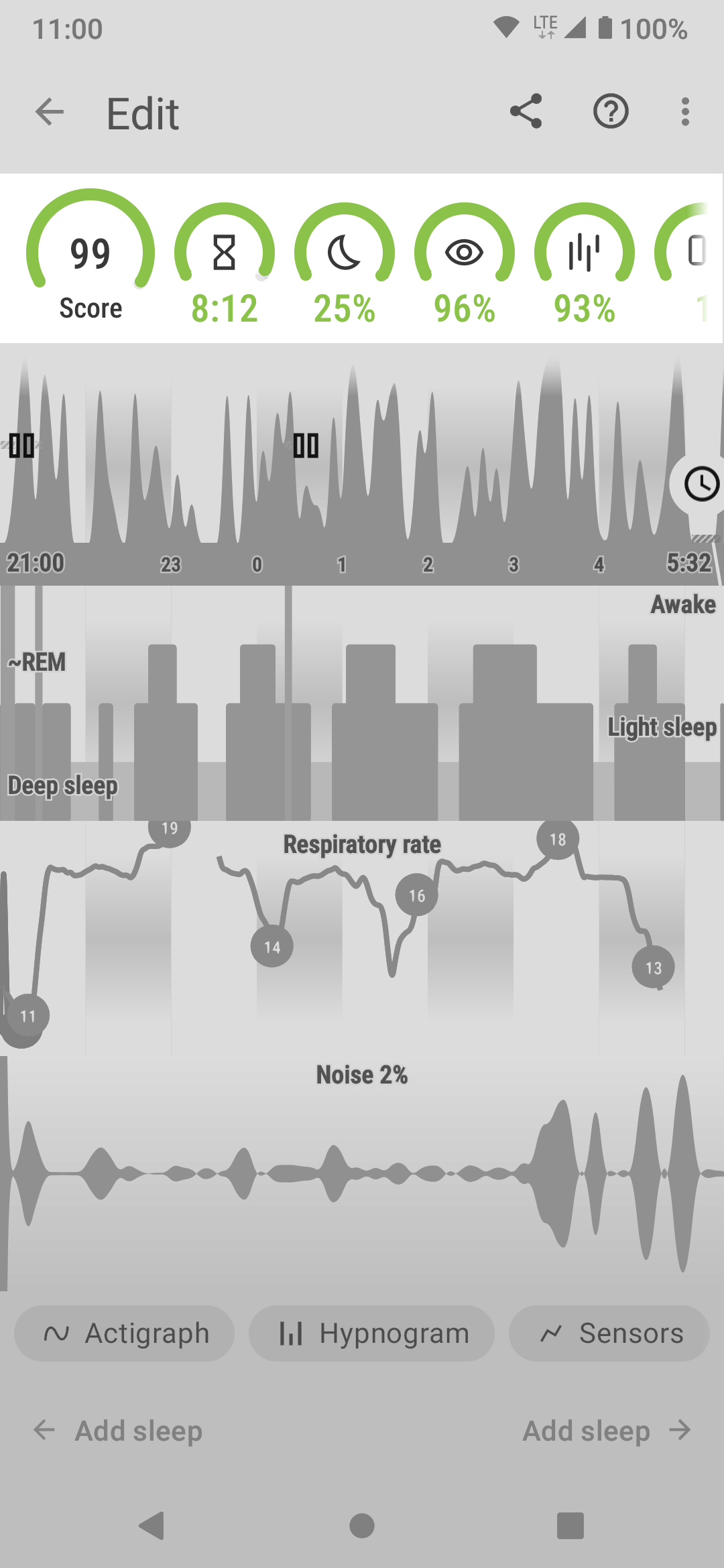
Figure 1. Sleep record statistics
|
|
6.5. Actigraph (Movement)
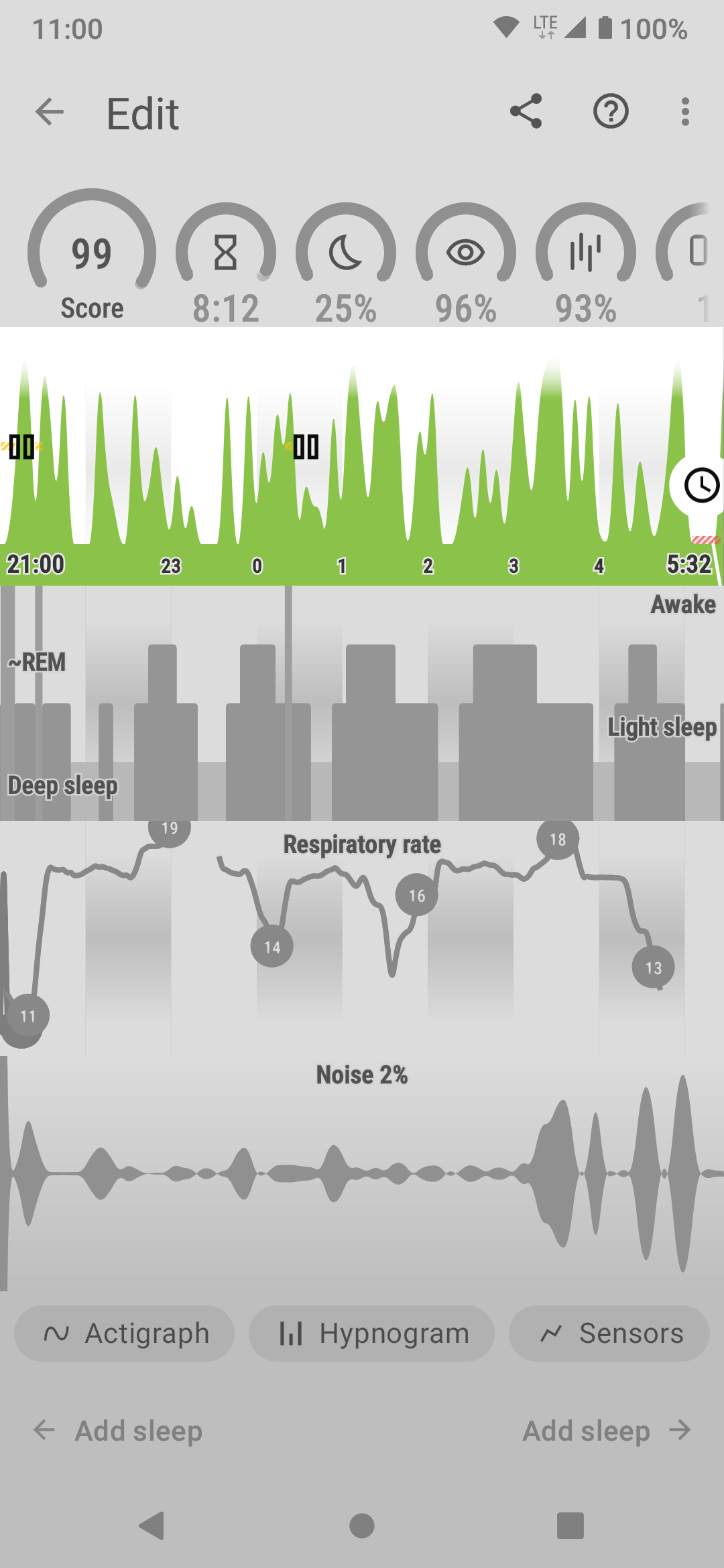
Figure 2. Actigraph
|
|
6.6. Hypnogram (Sleep phases)
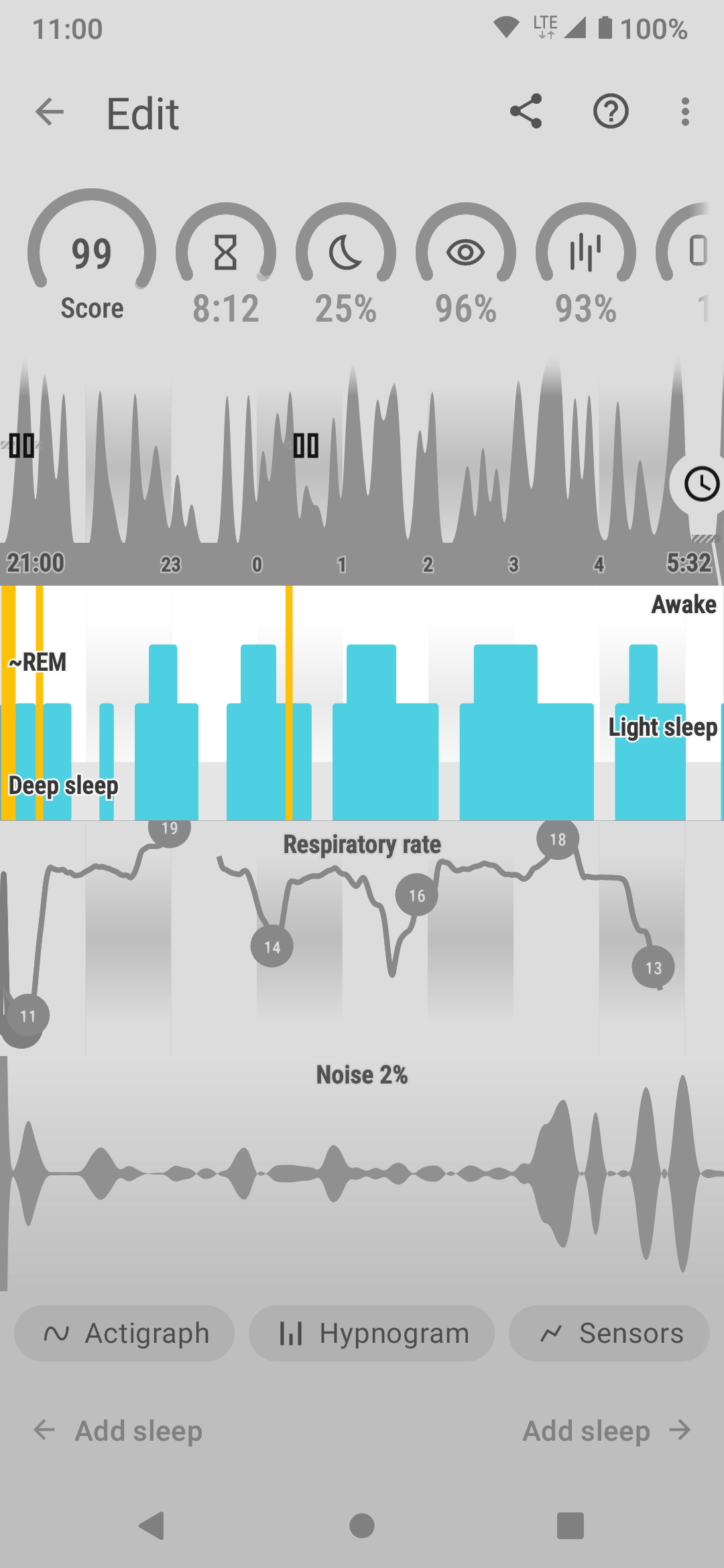
Figure 3. Hypnogram
|
|
6.7. Sensor Data Lines
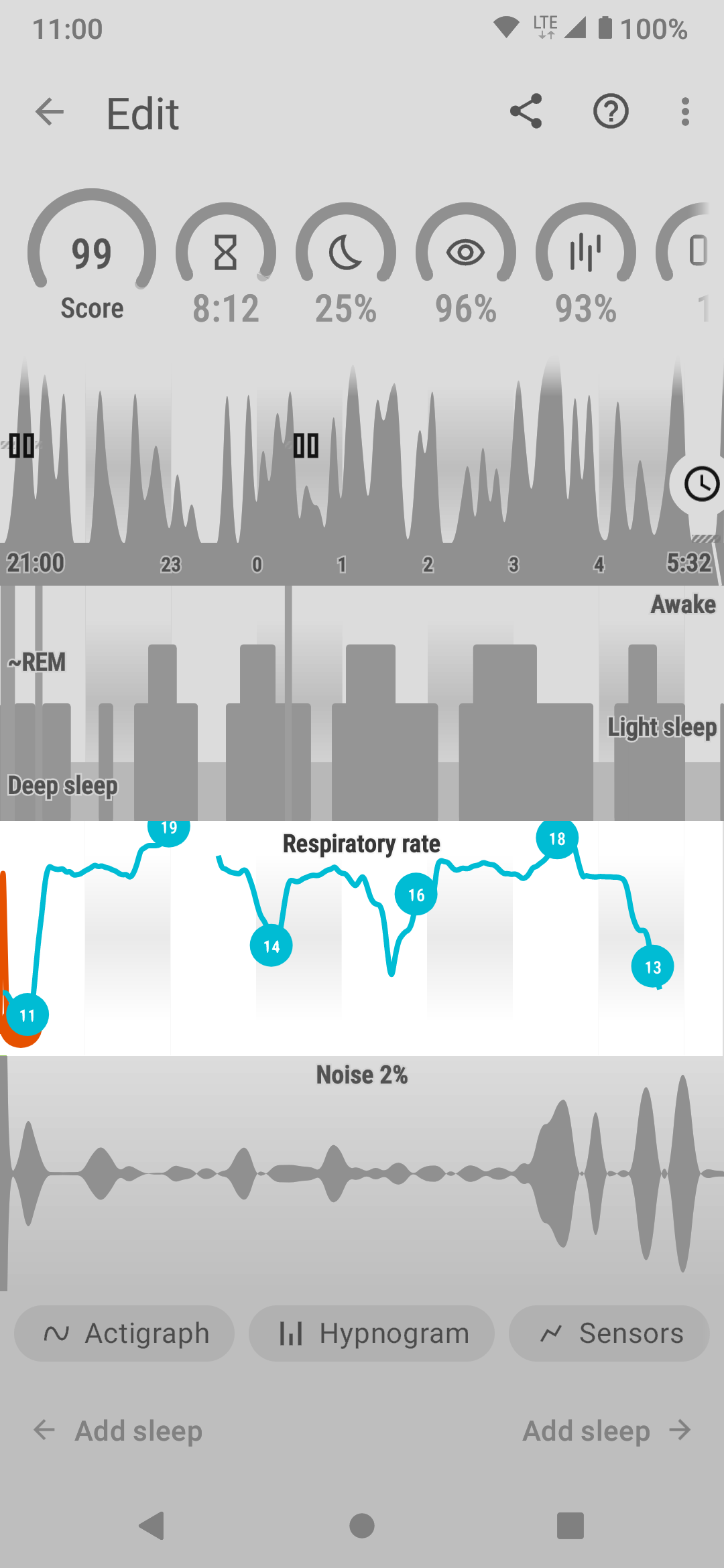
Figure 4. Breath rate + light level
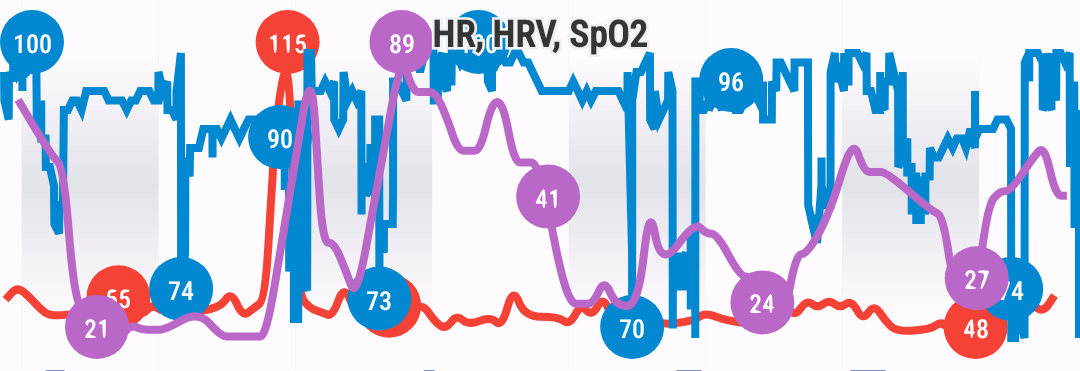
Figure 5. SpO2 data + HR + HRV
|
|
6.8. Noise graph & Recognition
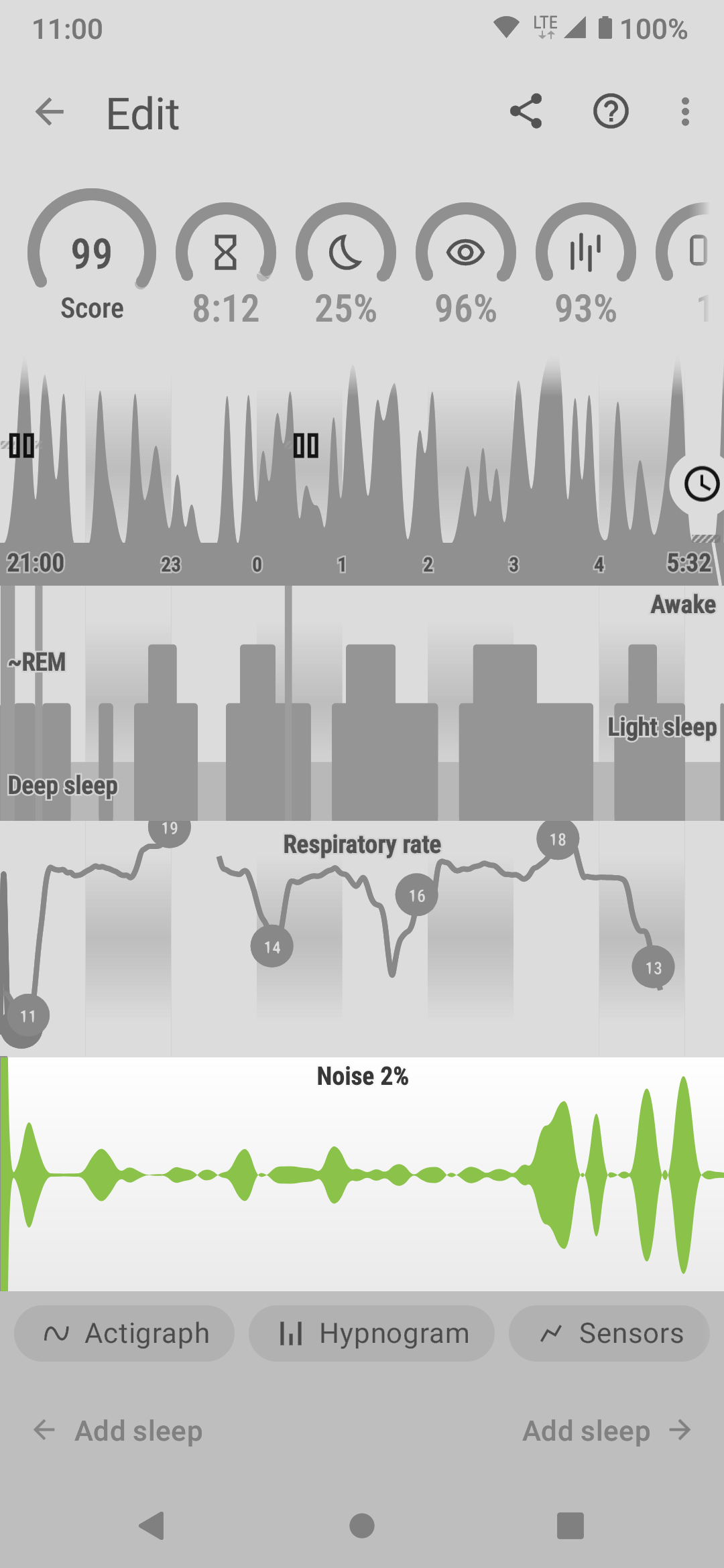
Figure 6. Noise graph
|
|
6.9. Markers and Icons
We use specific icons to mark events that occurred during your tracking session.
Icons on Actigraph |
|


Icons on Noise graph |
|


7. Comparing Sleep as Android graphs to sleep lab
Ever wondered, how precise the sleep tracking with only a mobile phone could be?
We had the opportunity to compare our algorithms with sleep-lab clinical study, and the results are very promising!
The chances the smart alarm will be triggered properly (not in deep sleep) is 96%.
Lucid cues have a 50% change to hit REM phase.
Awake periods just from movement intensity changes (no other awake heuristic like sound detection, light detection, HR monitoring) can be detected with 30% success.
You can read more details about the study on our blog post here.
If you are interested how the REM detection with Sleep as Android works, you can read it here.
FAQ
It is possible to revert up to 5 changes made while editing a graph.
-
You can use the Undo banner (appears each time you change a graph):
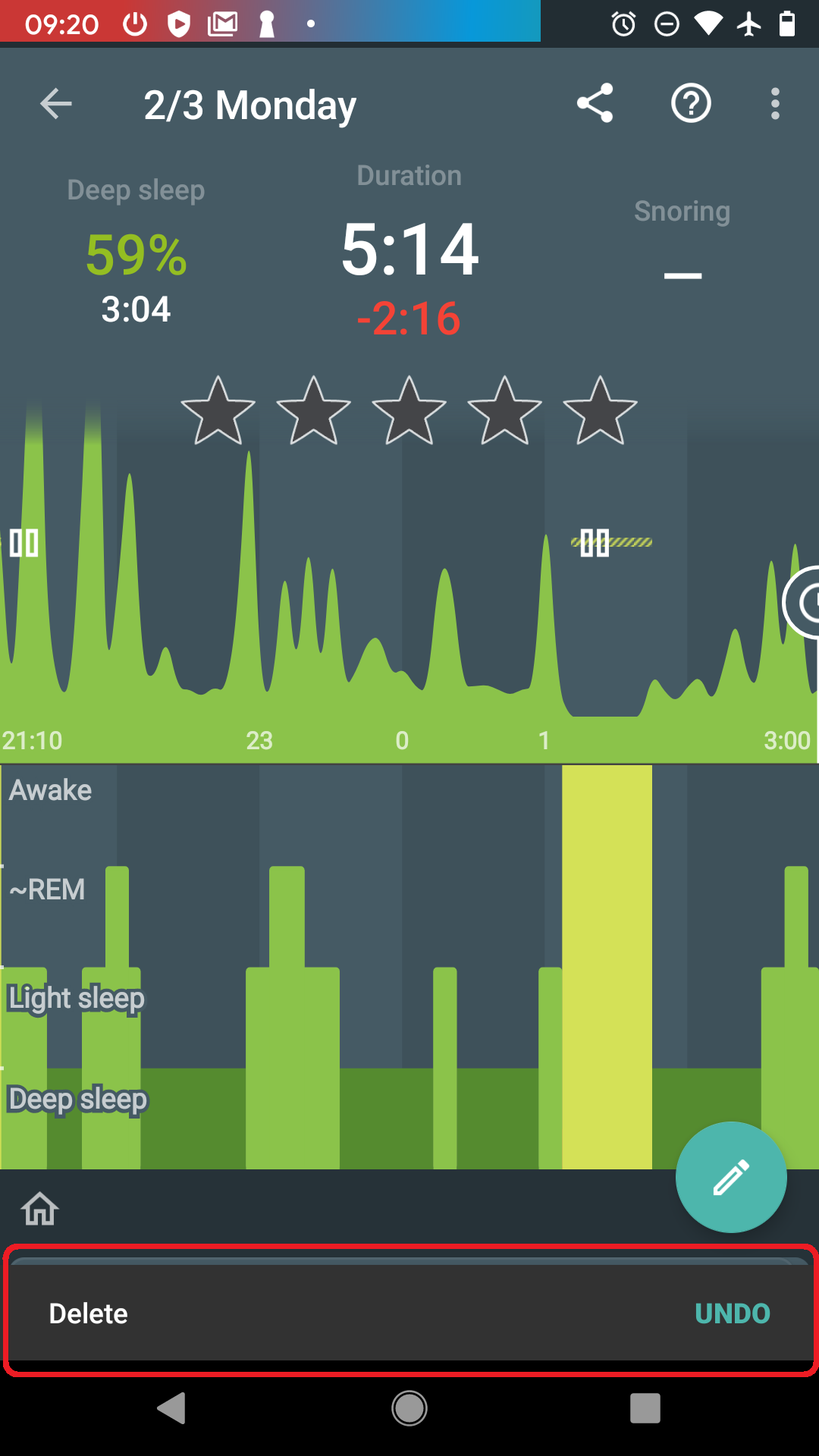
-
Or you can use ⋮ menu → Undo option
If you delete the graph from the Sleep app and it comes back later, check if the graph has  icon. These graphs are synced from an external service - either Samsung Health, Health Connect, or Google Fit.
If you delete the graphs there too, the they won’t reappear in the Sleep when you delete them.
Sleep duration is the sum of all your sleep stages (light, REM, and deep), not including waking stages - because you are not really sleeping when you are awake.
So on default settings, your Sleep Duration ,ay be a little shorter than your tracking time.
If you want your sleep duration to be the same as your tracking duration:
-
Disable the awake detection in Settings → Sleep tracking → Awake detection.
-
You can also try to adjust the sensitivity of each type of settings to get optimal results. In most cases, too many awake periods are caused by significant HR peaks.
-
If you are not sure, where these awake periods are coming from, please use the Left ☰ menu →
 Support →
 Report a bug, and send us the application log.
We use a different input than polysomnographists, and define our own sleep phases, reflecting an objective aspect of sleep, easy to measure with common devices. One naturally needs to ask whether there is any relationship between the EEG-phases and our ACT-phases.
Fortunately, several research teams raised similar questions before (See this one, or this one, or this one, or this one). They measured a bunch of people on a traditional polysomnograph and recorded their physical activity at the same time (By filming them and then counting the movements manually, or by using accelerometer readings). The published analyses show that there indeed is a significant statistical relationship between EEG-phases and body movements.
You can also read about comparison of Sleep as Android algorithms and Sleep lab results on our blog here.
Accelerometers are really sensitive, which is great for sleep tracking. Usually what you see when you leave the phone on the table is immediately dwarfed when you make a more significant movement. Just leave the phone on the table for a while and you will see a dramatic spike, but then move the phone and you will see that all the development is really tiny compared to the new peak.
So what you see is random noise caused by very small vibrations of the table or in very quiet areas by seismic movement. We mark the data relatively, so you can always distinguish between light and deep sleep. However, the algorithm works well only in conditions, it assumes i.e. in the bed with relatively large movement peaks.
To be more precise, if you leave the phone on a table, you may get values perhaps in the range of 0.000001 to 0.000009 m/s2 (the value is made up here, but it is physically very small). In the bed, you can get values from 1 to 9 m/s2 (which is physically large). However, the algorithm only sees that the high value is 9 times higher than the low value in both cases.
We had to do this because each accelerometer (in different phones) measures differently, so we couldn’t assume a standard conversion formula that responds to absolute values.
So if you use the phone in bed, it is indeed drastically different from measuring in a quiet place, like the table.
Please do not hesitate to contact support@urbandroid.org for clarification. You can also read more about how our data compares to sleep lab results at in this post.
There are several reasons why your graphs may be flat.
If you can see some movement on the actigraphy, but the graph is unusually flat:
. Sonar - make sure the signal is strong enough by keeping the sonar volume at max at Settings → Sleep tracking → Test sensor → blue sliding bar.
- You can also try a different frequency by selecting other frequency from the drop-down menu list in Settings → Sleep tracking → Test sensor → Frequency
- Keep the phone closer to your bed.
- Try different positions of the phone.
. Accelerometer - try keeping the phone closer to you.
-
Disable all system restrictions applied to Sleep as Android, or any companion app for tracking with a wearable: https://dontkillmyapp.com/
-
If there are too many awakenings falsely estimated on your graph, use the Left ☰ menu →
Support → Report a bug, and send us the application log. -
Most often the awakes are driven by significant HR peaks (awakes align with HR red line graph), you can try to disable this type of awake detection in Settings → Sleep tracking → Awake detection → Heart rate monitoring.
-
Another common cause is phone screen turned on, you can try disabling the Awake when using phone awake detection in Settings → Sleep tracking → Awake detection → Awake when using phone.
If the tracking stops completely after few minutes, the background processes are restricted by your system.
-
Make sure no system restrictions are applied to Sleep as Android, or any companion app for a tracking with wearable: Check our guide here.
-
If the guide won’t help, send us your log using Left ☰ menu →
Support → Report a bug.
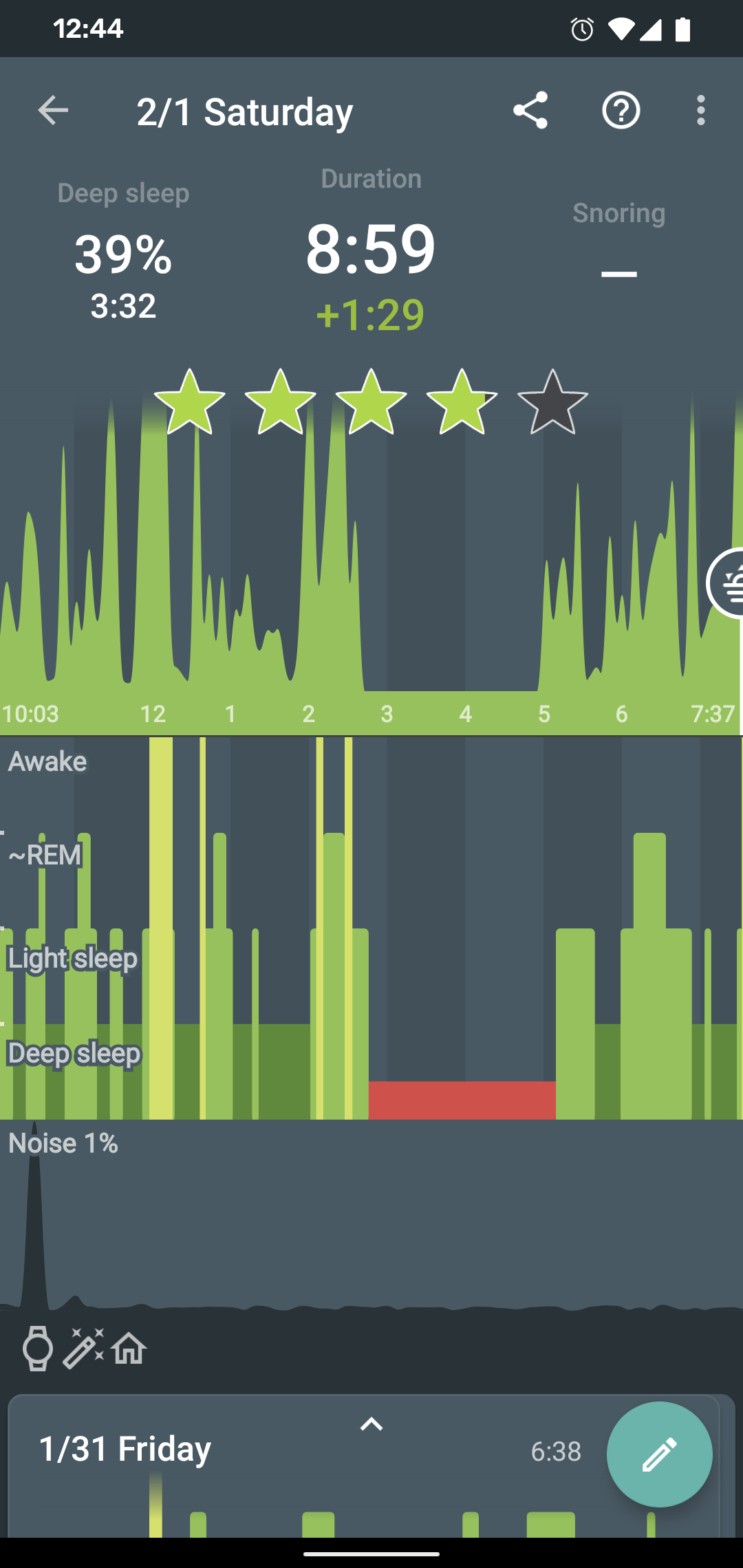
The red block indicates that something went wrong with tracking at that time and the device stopped providing sensor data for some reason. Usually those are some non-standard battery optimizations or battery savers, the battery gets too low so we preserve it for the alarm or connectivity issue if you use a wearable.
1. Battery restrictions
Make sure no system restrictions are applied to Sleep, or any involved apps like wearable companion app).
See our guide here, and follow the instructions.
2. Too low battery
When the battery is too low (usually below 10%), data collecting is terminated to preserve enough battery for alarm.
When the battery was too low, there is a battery icon is displayed on the graph:
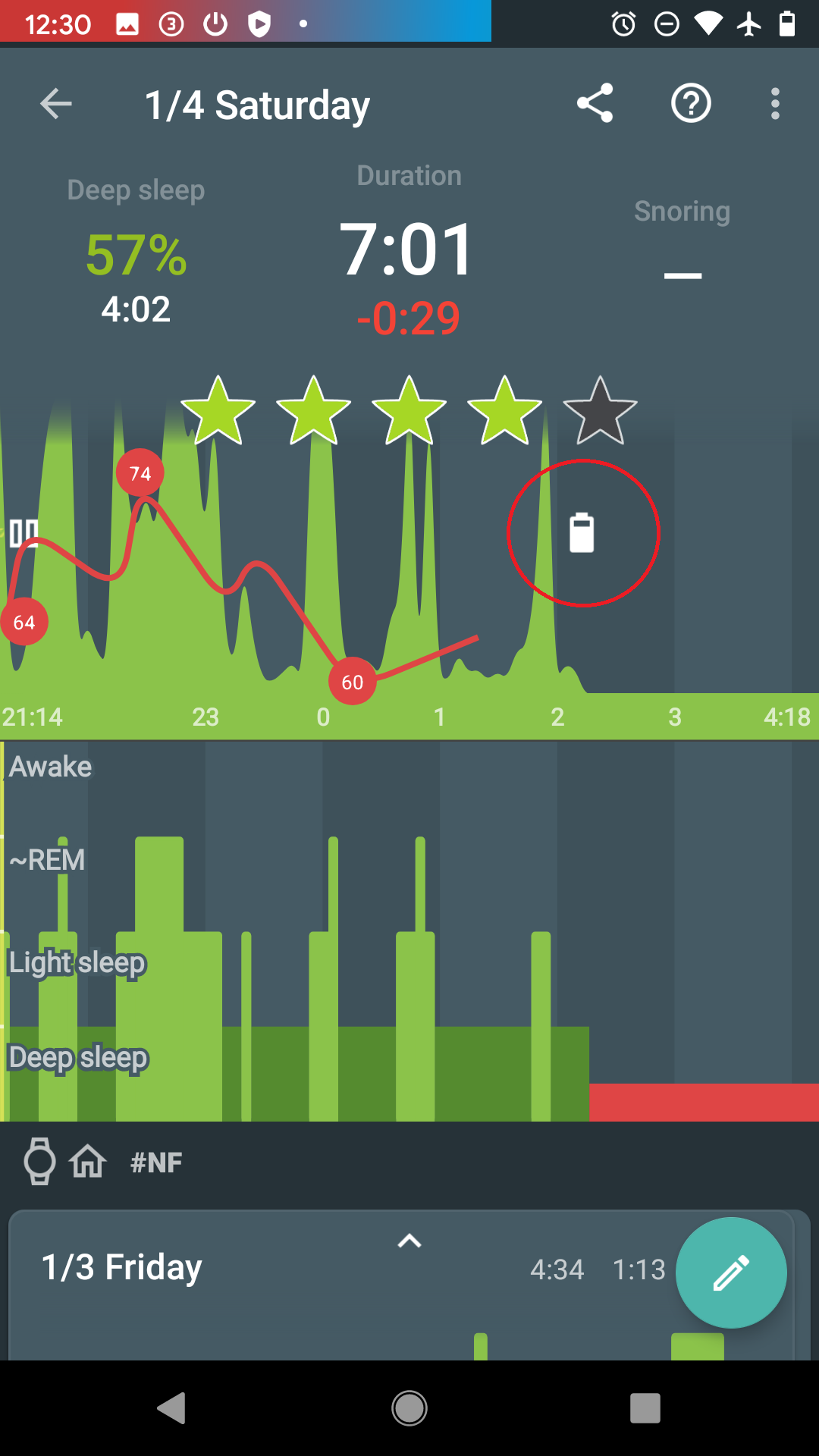
3. Connectivity issues with a wearable
When the connection with the wearable is lost, you can see red sections on the graph. The app always tries to reach the wearable again.
The graph can look like this:
-
Opt-out from any battery restrictions is applied by your system (https://dontkillmyapp.com/)
-
Pair the wearable with your phone in System settings.
-
Make sure the BT is not lost, and try lowering the distance between the phone and the wearable.
-
Try settings the device as Trusted device.